Webhook Relay
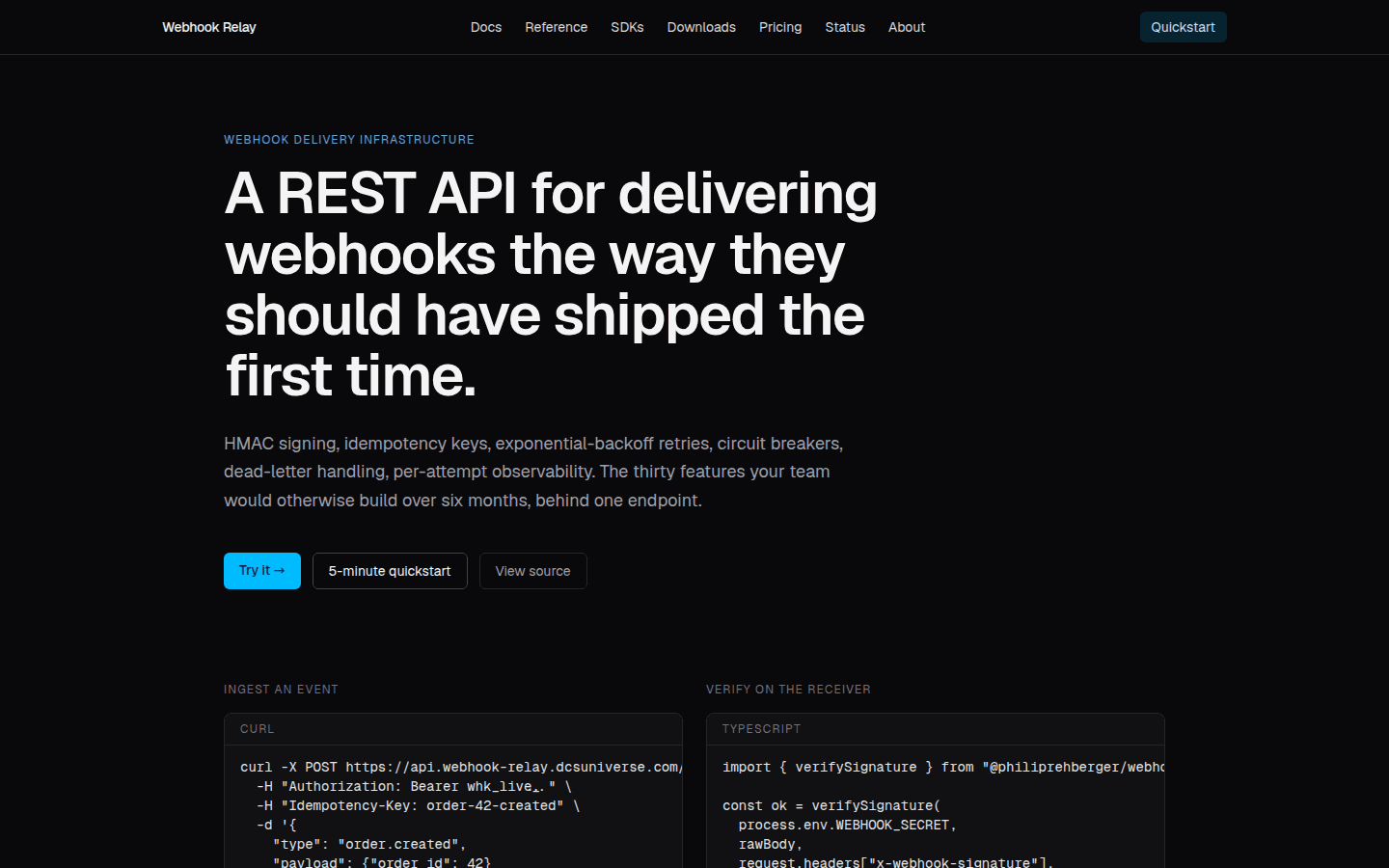
Production-shaped webhook delivery API with HMAC signing, idempotency keys, exponential-backoff retries, dead-letter handling, per-attempt observability, and SDKs in four languages.
Overview
A portfolio build that demonstrates the whole product surface a serious API client expects — endpoints, ergonomics, reliability semantics, generated SDKs, interactive docs, an operator dashboard, and a deploy story — not just an API behind a README.
Reliability features:
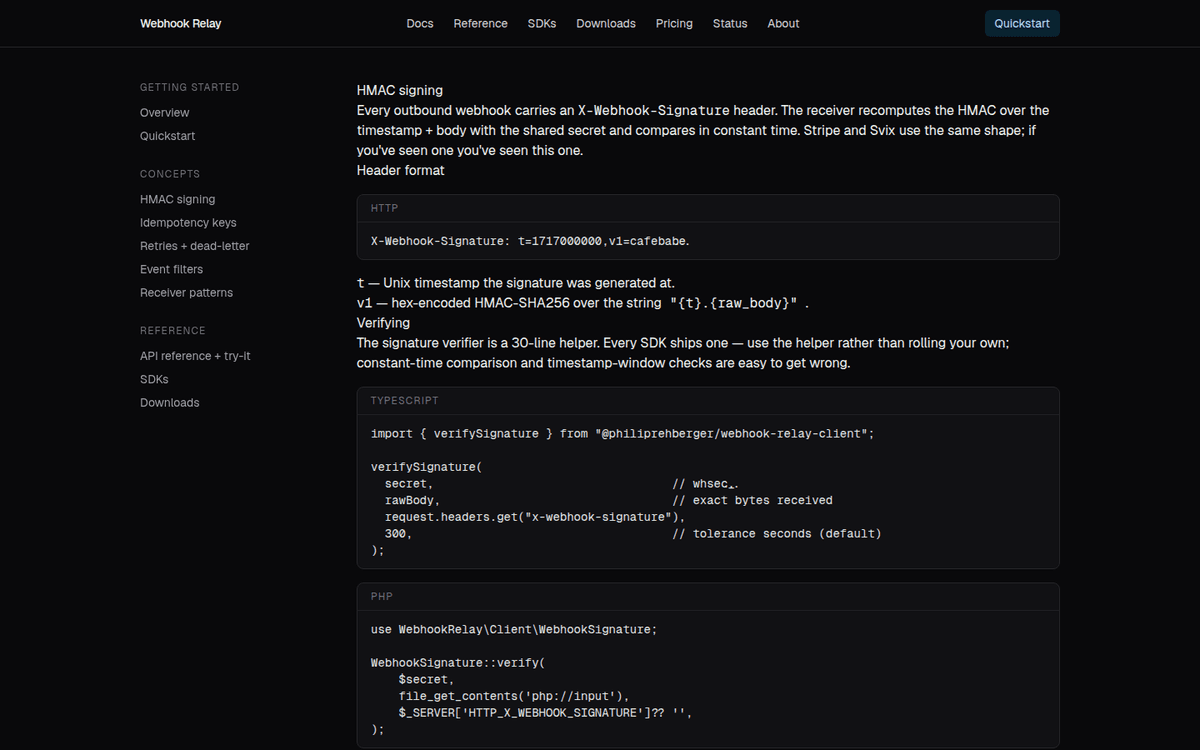
- HMAC-SHA256 outbound signing in the Stripe/Svix
t=…,v1=…header format. Each SDK ships a hand-tunedverifySignaturehelper with constant-time comparison and timestamp-window enforcement. - Idempotency keys on event ingest with a 24-hour dedup window. Separate idempotency-records table sidesteps MySQL's lack of partial unique indexes; same key + same payload returns the cached response, same key + different payload returns 409.
- Exponential-backoff retries — 30s, 2m, 10m, 1h, 6h — across five retries after the first attempt. Sixth failure dead-letters the delivery.
- Per-subscription circuit breaker auto-pauses a subscriber after eight consecutive failures.
- Dead-letter queue with manual replay; the original attempt history stays intact for audit.
- Per-attempt observability — every attempt records HTTP status, latency, signature header, whitelisted response headers, and a 4 KB body snippet.
- SSRF guard refuses outbound delivery to private / loopback / link-local IPs.
- Workspace-scoped rate limits with
X-RateLimit-*headers exposed cross-origin so the try-it console can show them. - Signing key rotation with a 48-hour grace window — old secret stays valid while receivers update.
Surface:
- 16 REST endpoints under
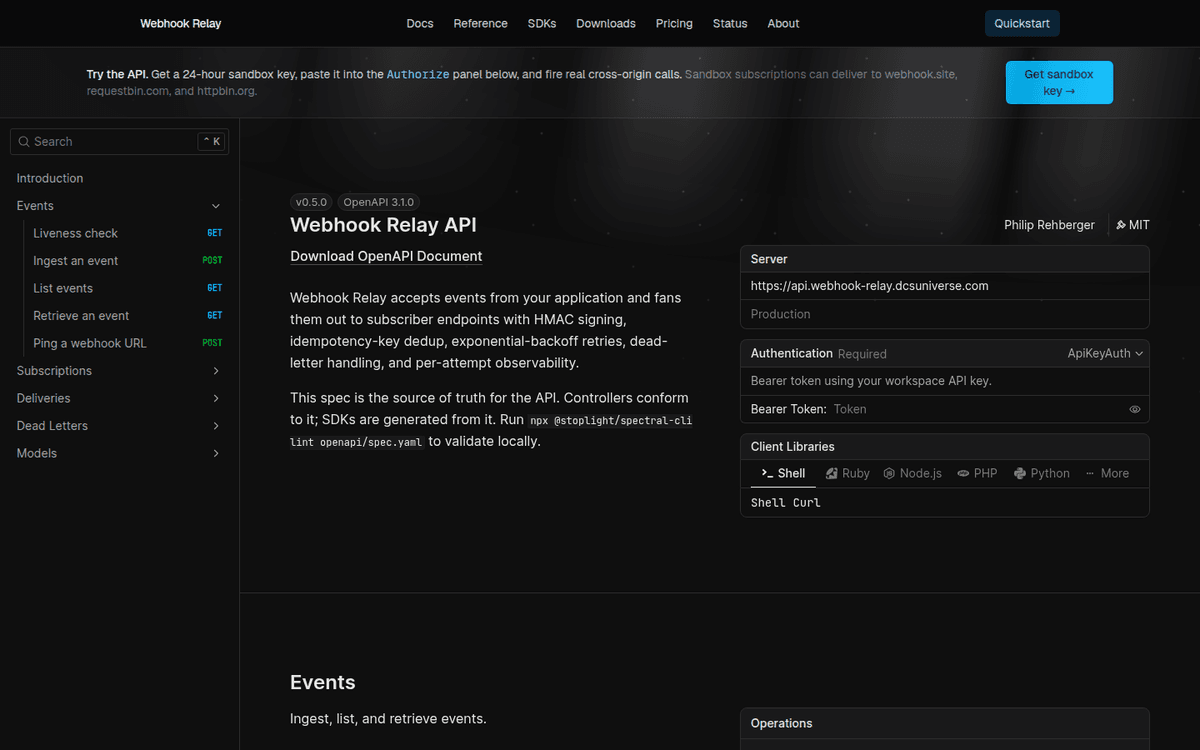
/v1/— events, subscriptions, deliveries, dead-letters, webhook-test probe, healthz. - OpenAPI 3.1 spec hand-authored as the source of truth; controllers conform to it. CI lints with Spectral and fails on SDK drift.
- Filament 4 admin dashboard — workspaces, events with payload viewer, subscriptions with pause/resume/rotate actions, deliveries with full attempt timeline and retry, API keys with mint-once-show-once flow. Dashboard widgets: events 24h, deliveries 24h, success rate, dead-letter open count, failing-subs table.
- Next.js 16 docs site at the brand domain — 21 statically rendered routes, Scalar-powered interactive try-it console at
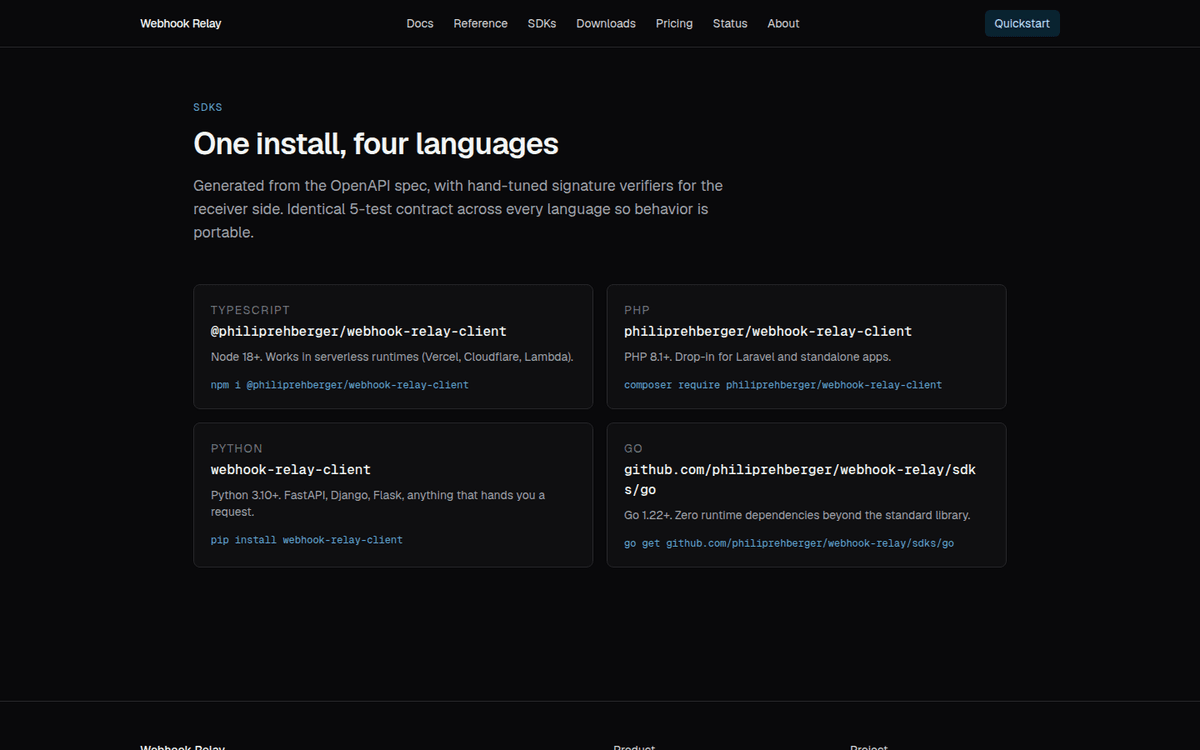
/reference, conceptual guides for signing/idempotency/retries/filtering/receivers, per-language SDK pages, downloads page with OpenAPI YAML/JSON + Postman collection + SDK zips. - SDKs in TypeScript, PHP, Python, Go. Generated from the spec, hand-tuned signature verifiers, identical 5-test contract across all four languages.
Stack:
- Laravel 13.14, PHP 8.3, MySQL 8, Redis + Horizon (under supervisord), Filament 4, Apache + mod_php, Let's Encrypt
- Next.js 16, Scalar API reference, Tailwind 4
- @openapitools/openapi-generator-cli 7.22 for SDK generation
- PHPUnit + ParaTest for the API suite
What it proves:
The same person who hand-authored the OpenAPI spec wrote the controllers, generated the SDKs, hand-tuned the verifier helpers, built the Filament dashboard, scaffolded the Next.js docs site, wired the deploy pipeline, and shipped it live. The case for hiring me to build a single coherent API product instead of stitching together a backend dev + frontend dev + DevOps + tech writer.
Results
66 PHPUnit tests + 20 SDK signature tests, all passing
21 statically rendered docs routes, Lighthouse desktop 100 / 95 / 100 / 100 on the landing
SDKs in 4 languages from one spec, each with a hand-tuned signature verifier
Atomic release-based deploy via SSH + rsync, zero-downtime symlink switch
Gallery